
Most of us think acne begins when a pimple appears.
It makes sense. That’s the moment we can see it.
But by the time that spot appears on the surface of your skin, the story has already started somewhere you can’t see — inside a tiny hair follicle.
If you’ve ever wondered why a pimple can seem to arrive overnight, or why the same skincare routine works for one person and does nothing for another, the answer usually isn’t on the surface. It’s underneath it. So before we talk about anything you can see, let’s go where acne actually begins.
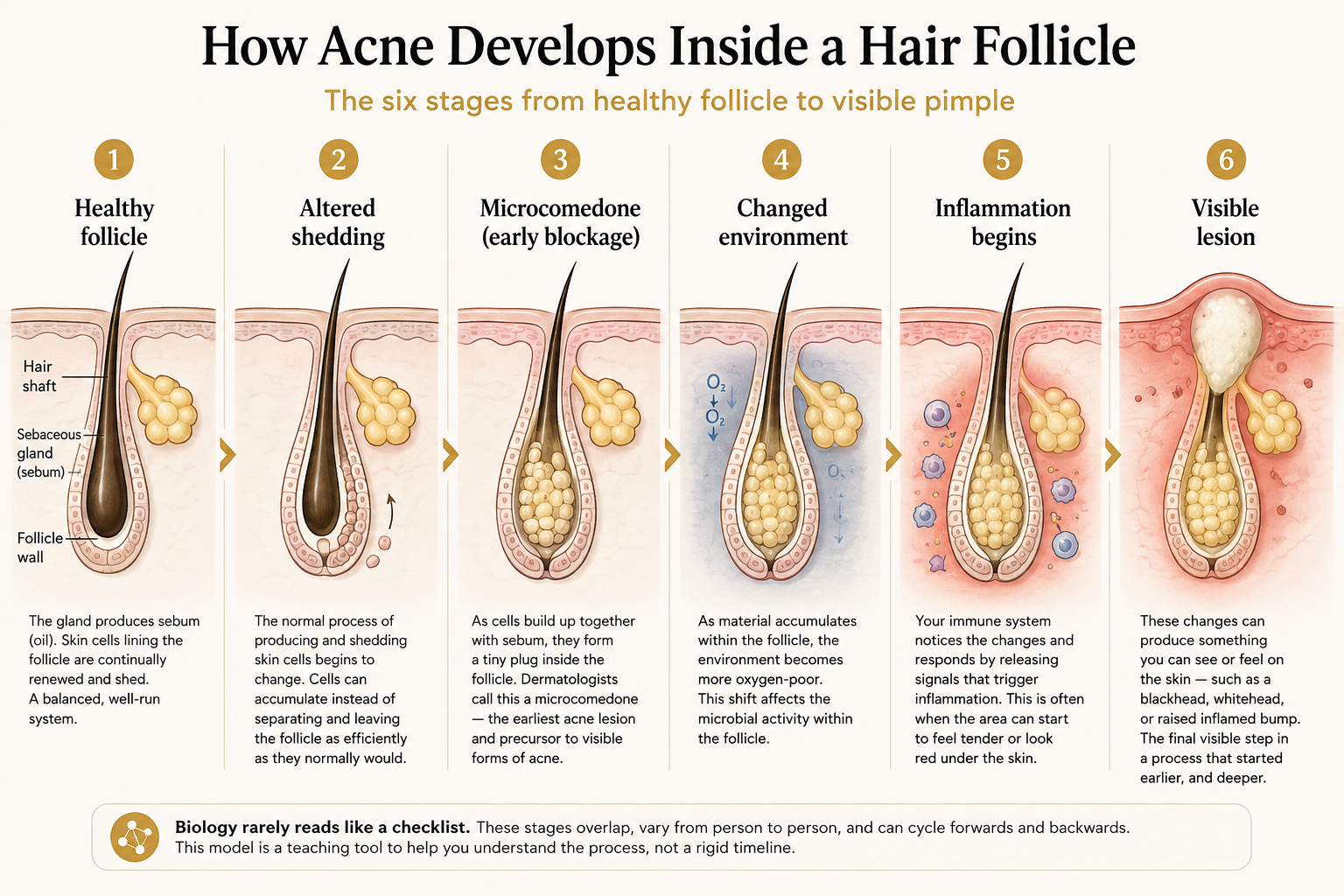
Inside a healthy follicle
Every hair on your body grows out of a small structure called a follicle, and most follicles on your face are paired with a tiny gland that produces oil, called sebum. Under normal conditions, this is a quiet, well-run system: the gland produces sebum, while cells lining the follicle are continually renewed and shed.
There’s nothing going wrong here. This is just what skin does, all the time, without you noticing.
When shedding changes
Acne starts with a change to that quiet system. Inside the follicle, the normal process of producing and shedding skin cells begins to change. Cells can accumulate instead of separating and leaving the follicle as efficiently as they normally would.12
On its own, this isn’t something you’d feel or see. It’s a shift happening at a cellular level, well before anything reaches the surface.
A microscopic blockage
As those cells continue to build up, together with the oil the gland is producing, they form a tiny plug inside the follicle. Dermatologists call this a microcomedone, traditionally recognised as the earliest acne lesion and the precursor to visible forms of acne.1
At this stage, it’s genuinely invisible. You couldn’t find it by looking in the mirror or running a finger over your skin.
And this is an important moment in the story. Nothing necessarily looks wrong from the outside. The surface of your skin may appear completely normal. But inside that follicle, the conditions are no longer the same as they were before.
The environment inside changes
As material accumulates within the follicle, the local environment changes, including becoming more oxygen-poor — and that shift affects the microbial activity within the follicle.23
This is where it’s worth pausing on something that gets misunderstood a lot: acne isn’t bacteria “arriving” and causing an infection. The bacteria most associated with acne are not foreign invaders — they’re already there, on healthy skin, all the time. What changes is the environment around them — and that’s a very different story to the one most people have heard.
The immune system responds
As conditions inside the follicle continue to shift, your immune system starts to notice. It responds the way it would to any other change it’s monitoring in the body — by sending signals that trigger inflammation.3
This is often where people assume the story begins, because it’s the point where things can start to feel different — a little tenderness, a little redness under the skin. For teaching purposes, we’re placing inflammation here because this is where its effects become easier to understand. But inflammation doesn’t necessarily wait until this point — as we’ll come back to shortly, evidence suggests it can begin much earlier.
What becomes visible
Eventually, these changes can produce something you can see or feel on the skin. Depending on exactly how it plays out, that might be a blackhead, a whitehead, or a raised, sometimes tender bump. This is the moment most of us would say “I have a pimple” — but as you’ve just seen, it’s really the last visible step in a process that started much earlier, and much deeper.
Biology rarely reads like a checklist
It’s useful to picture these six changes as a sequence, one leading into the next — and for understanding the general shape of acne, that’s a genuinely good way to think about it.
But biology is rarely that tidy. These processes can overlap rather than happen in strict order, and research suggests inflammation may already be present at very early stages of acne development — sometimes before the visible signs we usually associate with a “starting point” have even formed.345 The six stages above are less like a conveyor belt and more like six things that are all, to varying degrees, usually involved.
Why acne looks different from person to person
If acne followed exactly the same path in everyone, everyone’s skin would respond to exactly the same treatment. It doesn’t. The same biological processes are involved in acne, but their relative contribution can vary from person to person. That helps explain why acne doesn’t look, behave or respond to treatment exactly the same way in everyone.
That’s really the heart of it: two people can have what looks like “the same acne” and be dealing with meaningfully different versions of this process underneath.
Why understanding this matters for treatment
Once you see acne as the result of several interacting biological processes rather than a single event, it starts to make sense why there are different approaches to treating it — and why “just try this product” advice so often falls flat. Different approaches may target different parts of the acne process, and what matters most can vary from one person’s skin to another.
If you’re looking for professional support, learn more about our skin clinic in Ripley and how we approach skin assessment and treatment planning.
This is also why the same routine can work beautifully for a friend and do nothing for you. You may not have the same balance of underlying processes, the same contributing factors, or the same skin.
Looking for a routine for acne-prone skin? Understanding what contributes to acne is only the first step. A consistent skincare routine can support acne-prone skin without pretending that one product addresses every driver we’ve discussed here. Explore the Clear Glow Face Set.
If you’re not sure what’s driving your own skin
That’s exactly what a proper skin assessment is for — not guessing which product might help, but understanding which part of this process is actually most active in your case.
Frequently asked questions
What is the earliest stage of acne?
The microcomedone is traditionally recognised as the earliest acne lesion and the precursor to visible forms of acne.1 However, research suggests inflammatory changes may begin even earlier, before a microcomedone is clinically apparent.35
Can acne start before you can see or feel it?
Yes. Research has found early inflammatory changes inside follicles before any visible blockage had developed, suggesting the process can begin well before a spot is noticeable — sometimes referred to as the subclinical stage of acne.35
Does everyone’s acne develop in exactly the same way?
No. The same core biological processes are involved in acne, but their relative contribution and how they interact can vary. That helps explain why acne does not look or behave exactly the same way in everyone.
Is acne caused by dirty skin?
No. Acne develops from biological changes within the pilosebaceous unit, not because the surface of the skin is dirty.
Where in the skin does acne begin?
Acne begins inside the pilosebaceous unit — the hair follicle and its attached oil gland — well below the surface of the skin you can see or touch.12
References
- Sutaria AH, Masood S, Saleh HM, Schlessinger J. Acne Vulgaris. StatPearls [Internet]. NCBI Bookshelf NBK459173.
- Toyoda M, Morohashi M. Pathogenesis of acne. Medical Electron Microscopy. 2001;34(1):29–40.
- Huang L, Yang S, Yu X, et al. Association of different cell types and inflammation in early acne vulgaris. Frontiers in Immunology. 2024;15:1275269.
- Moradi Tuchayi S, Makrantonaki E, Ganceviciene R, Dessinioti C, Feldman SR, Zouboulis CC. Acne vulgaris. Nature Reviews Disease Primers. 2015;1:15029.
- Jeremy AHT, Holland DB, Roberts SG, Thomson KF, Cunliffe WJ. Inflammatory events are involved in acne lesion initiation. Journal of Investigative Dermatology. 2003;121(1):20–27.