
In Why Do Pores Get Clogged? we described what happens when normal shedding inside the follicle starts to change: cells that would ordinarily separate and leave begin to accumulate instead.
That change has a name in dermatology: follicular hyperkeratinisation.
It’s worth understanding properly, because it’s one of the terms you’ll see repeatedly if you read about acne treatment — and because knowing what it actually means makes the rest of the acne story much easier to follow.
Keratinisation, before we add “hyper”
Keratinisation is simply the normal process by which skin cells — keratinocytes — mature, move toward the surface, and shed. It happens throughout your skin, all the time, without causing any problem. Inside a healthy follicle, the same process governs the cells lining the follicular canal: mature, separate, shed, on schedule.
So what does “hyper” mean here?
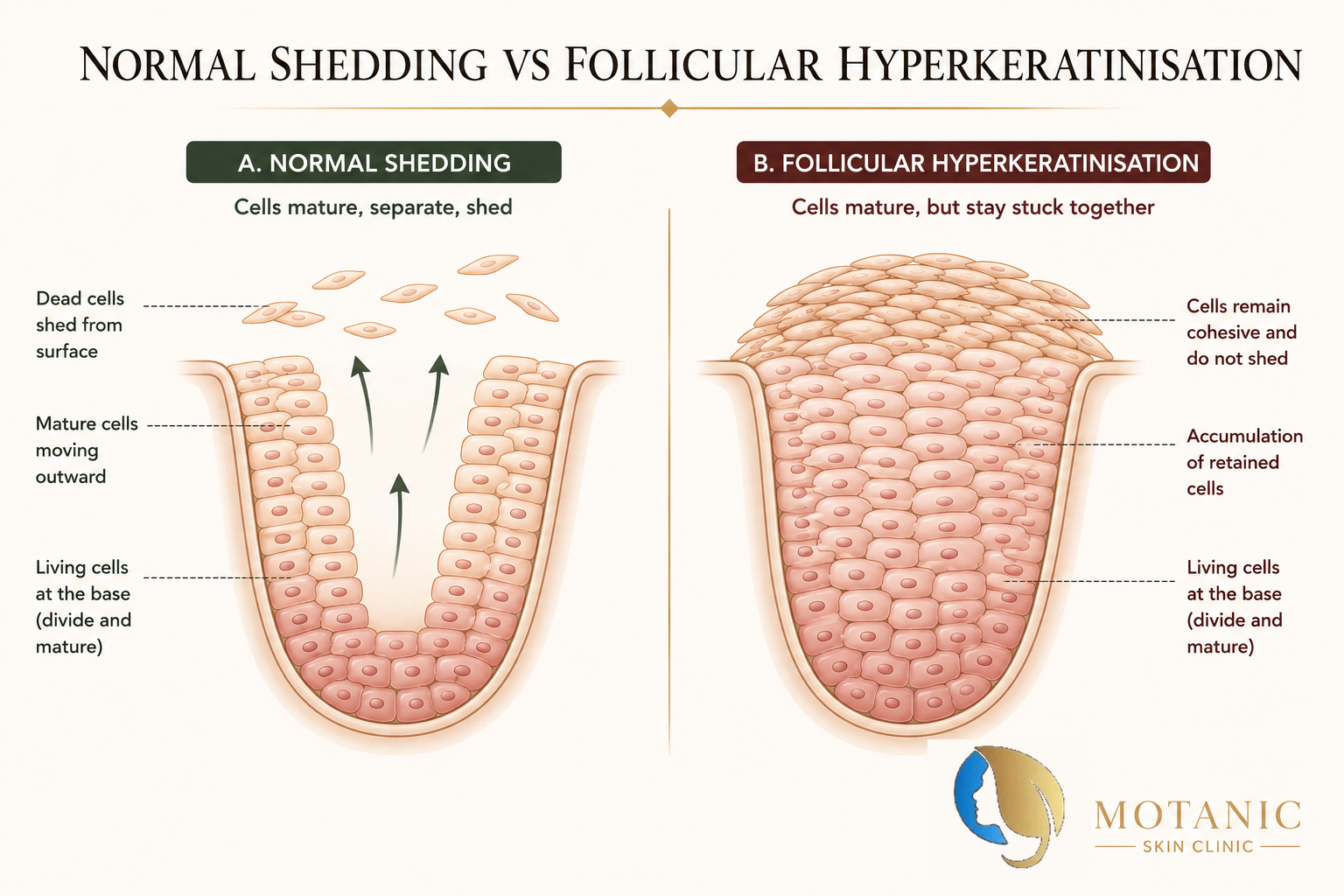
“Hyperkeratinisation” doesn’t simply mean cells are being made too quickly. The more accurate picture is that the cells become abnormally cohesive — they stick together rather than separating cleanly — which disrupts the normal mature-separate-shed sequence.1 The result is that cells that should shed are instead retained inside the follicle, where they accumulate.
This is exactly the change we described in plain terms in Why Do Pores Get Clogged? — here, we’re naming the mechanism and looking at it more closely.
Not the same as “hyperkeratosis” in general
You may also come across the broader term “hyperkeratosis,” which covers a range of unrelated skin conditions — calluses, keratosis pilaris, and others. Follicular hyperkeratinisation is a specific, acne-relevant process happening inside the follicle, not the same thing as those surface conditions, even though the words look similar.
Why this matters: the direct link to microcomedones
This is the mechanism behind what we called the microcomedone in Why Do Pores Get Clogged? The retained, cohesive cells contribute directly to that earliest plug — follicular hyperkeratinisation isn’t simply another event alongside microcomedone formation; it’s a key process driving its development.12
Normal: cells mature, separate, shed. Hyperkeratinisation: cells mature, but stay stuck together — allowing retained cells to begin accumulating inside the follicle.
Where does sebum fit in?
Changes in sebum composition, including lower relative levels of linoleic acid, have also been proposed as one factor that may influence abnormal follicular keratinisation.3 We’ll return to sebum in a later article — for now, the important point is that this isn’t a single-cause story. Follicular hyperkeratinisation is one important piece of a larger, interacting picture.
Why this matters for treatment
Understanding this mechanism explains why a specific class of treatment — retinoids, such as tretinoin and adapalene — targets this exact process. Their role is to help normalise follicular keratinisation itself, rather than simply treating what becomes visible afterward.1 We’ll cover treatment approaches properly in later articles; the point here is simply that naming the mechanism correctly is what allows treatment to target it correctly.
References
- Thiboutot DM. The role of follicular hyperkeratinization in acne. Journal of Dermatological Treatment. 2000;11(Suppl 2):5–8.
- Sutaria AH, Masood S, Saleh HM, Schlessinger J. Acne Vulgaris. StatPearls [Internet]. NCBI Bookshelf NBK459173.
- Letawe C, Boone M, Piérard GE. Digital image analysis of the effect of topically applied linoleic acid on acne microcomedones. Clinical and Experimental Dermatology. 1998;23(2):56–58.