
If clogged pores were simply caused by dirty skin, washing your face more thoroughly should solve them.
But it doesn’t.
That’s because what we call a clogged pore isn’t simply something sitting on top of your skin. It’s a change happening inside a structure just beneath the surface — and understanding that change is an important part of understanding acne itself.
In What Causes Acne? we looked at the changes that can take a healthy follicle towards a visible pimple. Here, we’re going to slow down and look closely at one of the earliest changes — the one that begins inside the follicle before you can see anything on the surface.
First, what exactly is a “pore”?
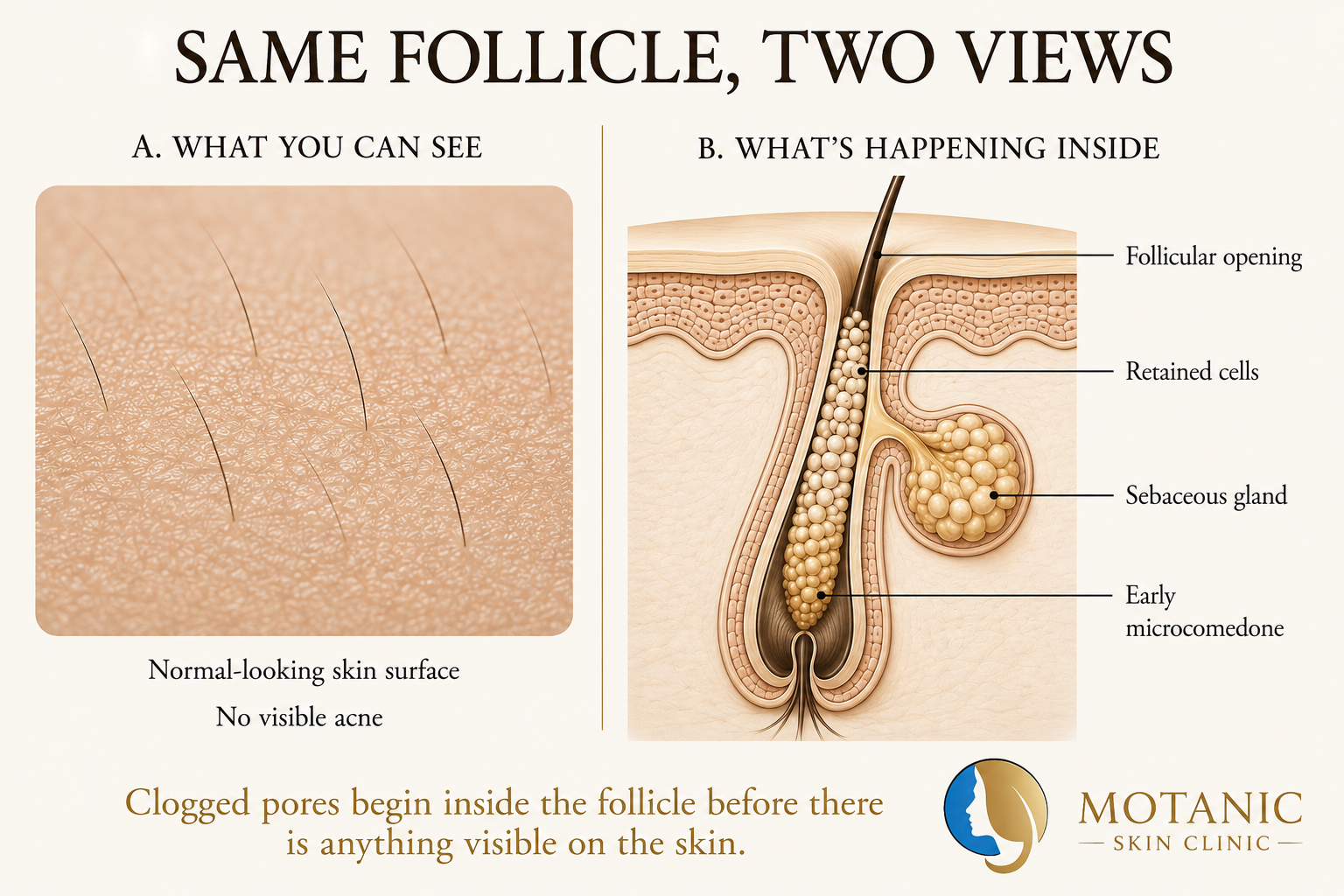
When people talk about a “pore,” they usually mean the small opening they can see on the surface of the skin. In acne-prone areas, many of these visible openings are the openings of hair follicles. Each follicle is part of a larger structure called the pilosebaceous unit, which includes a sebaceous gland that produces sebum and releases it into the follicle.
So when you look at a pore on the surface, you’re only seeing the entrance. The follicle itself extends beneath the skin — and that’s where some of the earliest changes involved in acne take place.
What normally happens inside a healthy follicle?
We covered this in detail in What Causes Acne? — in short, a healthy follicle is a quiet, well-run system. The sebaceous gland produces sebum, while cells lining the follicular canal are continually renewed and shed without accumulating into a plug.
An important early change: shedding stops behaving normally
One of the earliest changes associated with acne development occurs inside the follicle. The normal process by which cells mature, separate and shed starts to change. Instead of leaving the follicular canal efficiently, cells begin to accumulate.12
Nothing about this is visible yet. What we’re describing is a change taking place within the follicle itself, rather than simply a build-up of material sitting on the skin’s surface.
How a microcomedone begins to form
As this accumulation continues, retained cells and sebum contribute to the formation of a tiny plug within the follicle. This is called a microcomedone, classically recognised as the precursor lesion from which comedonal and inflammatory acne lesions can develop.1
The word sounds technical, but the idea is simple: it represents one of the earliest physical signs that the follicular environment has begun to change, long before a visible acne lesion appears on the surface.
Why you can’t see this happening yet
A microcomedone is microscopic, so it isn’t visible to the naked eye. The surface of your skin can still look completely normal while these early changes are developing within the follicle.
That’s the gap between what you can see and what’s actually happening underneath — and it’s one reason simply washing more doesn’t address the whole process.
Where does sebum fit into the story?
Sebum is part of this process, but it isn’t the whole story. Acne develops through several interacting processes — including altered follicular shedding, sebum production, changes within the follicular environment and inflammation — rather than oil alone.34
So while sebum contributes to acne development, saying that “oily skin causes acne” oversimplifies a much more complex process.
Does this mean clogged pores are caused by dirty skin?
No. A clogged follicle is not simply the result of dirt accumulating on the skin’s surface.
The process we’ve described — altered shedding, cell accumulation and microcomedone formation — develops within the follicle.12 That’s why simply washing more thoroughly doesn’t address the underlying process.
This doesn’t mean that external factors can never influence acne. It means that acne cannot be reduced to poor cleansing or dirty skin.
Why some follicles progress and others don’t
Not every follicle that experiences these early changes goes on to develop a visible acne lesion, and not everyone’s skin is affected to the same degree.
The same underlying processes are involved, but how strongly each one contributes can vary from person to person.3 We’ll explore some of the reasons for that variation in later articles. For now, the important idea is that acne development is not a single, fixed outcome.
A clogged pore isn’t a dirty pore. It begins when normal processes inside the follicle start behaving differently — and that distinction changes how we think about acne.
How Acne Really Begins Inside Your Skin
Continue the lesson visually and see how one of acne’s earliest changes develops inside the hair follicle.
What this means for acne treatment
Once you understand that some of acne’s earliest changes occur within the follicle rather than simply on the skin’s surface, it becomes clearer why cleansing alone isn’t a complete answer.
Different approaches address different parts of the acne process — some influence how cells shed, while others target different aspects of the follicular environment. What matters most can vary from one person’s skin to another.
If you’re looking for professional support, learn more about our skin clinic in Ripley and how we approach skin assessment and treatment planning.
Where cleansing fits. Cleansing remains an important part of caring for acne-prone skin, but it shouldn’t be confused with physically washing a developing blockage out of the follicle. AcneClear Foaming Wash is formulated for acne-prone skin as part of a broader skincare routine.
What happens next?
We’ve now looked closely at one of the earliest changes that occurs within an acne-prone follicle. The next question is what happens as those changes continue — how the environment inside the follicle shifts further, and why that matters for what comes next in the acne process.
That’s where we’re headed next in the Motanic Knowledge Library.
If you’re not sure what’s driving your own skin, that’s exactly what a proper skin assessment is for.
Frequently asked questions
What exactly is a pore?
In the context of acne, what we commonly call a pore is the visible opening of a hair follicle at the skin’s surface. The follicle extends beneath the surface and is associated with a sebaceous gland that produces sebum.
Is a clogged pore caused by dirty skin?
No. A clogged follicle isn’t simply caused by dirt accumulating on the surface. The process involves changes occurring within the follicle, including altered cell shedding and accumulation.12
Can washing your face more prevent clogged pores?
Not on its own. Cleansing is an important part of skincare, but washing more thoroughly doesn’t correct the biological process happening inside the follicle. Cleansing alone isn’t a complete strategy for preventing acne.
What is a microcomedone?
A microcomedone is a microscopic plug that develops within the follicle as cells and sebum accumulate. It is classically recognised as a precursor lesion from which visible acne lesions can develop.1
Do clogged pores develop the same way in everyone?
The same broad biological processes are involved, but their relative contribution can vary between individuals. That’s one reason acne can behave and appear differently from one person to another.3
References
- Sutaria AH, Masood S, Saleh HM, Schlessinger J. Acne Vulgaris. StatPearls [Internet]. NCBI Bookshelf NBK459173.
- Toyoda M, Morohashi M. Pathogenesis of acne. Medical Electron Microscopy. 2001;34(1):29–40.
- Huang L, Yang S, Yu X, et al. Association of different cell types and inflammation in early acne vulgaris. Frontiers in Immunology. 2024;15:1275269.
- Moradi Tuchayi S, Makrantonaki E, Ganceviciene R, Dessinioti C, Feldman SR, Zouboulis CC. Acne vulgaris. Nature Reviews Disease Primers. 2015;1:15029.