
If you’ve ever had oily, acne-prone skin, you’ve probably been told that the oil is the problem.
It sounds logical. Your skin feels oily. Your pores become clogged. Pimples appear. So remove the oil, and the acne should improve. But the relationship between sebum and acne isn’t quite that simple.
But that explanation leaves out something important. Sebum is supposed to be there.
Healthy skin produces it every day. The sebaceous gland doesn’t suddenly become useful only when acne disappears — it’s part of the normal pilosebaceous unit we looked at in Understanding the Pilosebaceous Unit. So the more useful question isn’t simply “why is my skin oily?” It’s: what changes when sebum is produced inside an acne-prone follicle?
What sebum actually does
Sebum isn’t a byproduct or a mistake of oily skin — it’s a substance your skin produces on purpose. It helps lubricate the skin, supports the skin’s barrier, contributes to water retention, and plays a role in the skin’s antimicrobial and immune defences.1 Some of the individual fatty acids within sebum even have their own antibacterial properties, contributing to the skin’s normal defences rather than working against them.1 None of this stops happening in people who develop acne. Sebum keeps doing its job — the question is what else is happening alongside it.
Where it comes from
Sebum is produced by the sebaceous gland, released through holocrine secretion, and travels into the follicular canal — the same structure and process we described in detail in Understanding the Pilosebaceous Unit. From there, it normally makes its way to the surface without any issue.
Does oily skin automatically mean acne?
No — and this is one of the more genuinely interesting parts of the science. Some people produce a lot of sebum and never develop significant acne. Others develop acne without appearing exceptionally oily.2
Acne depends on several interacting follicular processes, not oil production in isolation — and science does not yet completely explain why apparently similar levels of oiliness can produce such different outcomes between individuals.2 That’s not a gap in this article; it’s a genuine limit of current understanding.
What actually changes during acne
Two separate things can change, and it’s worth telling them apart.
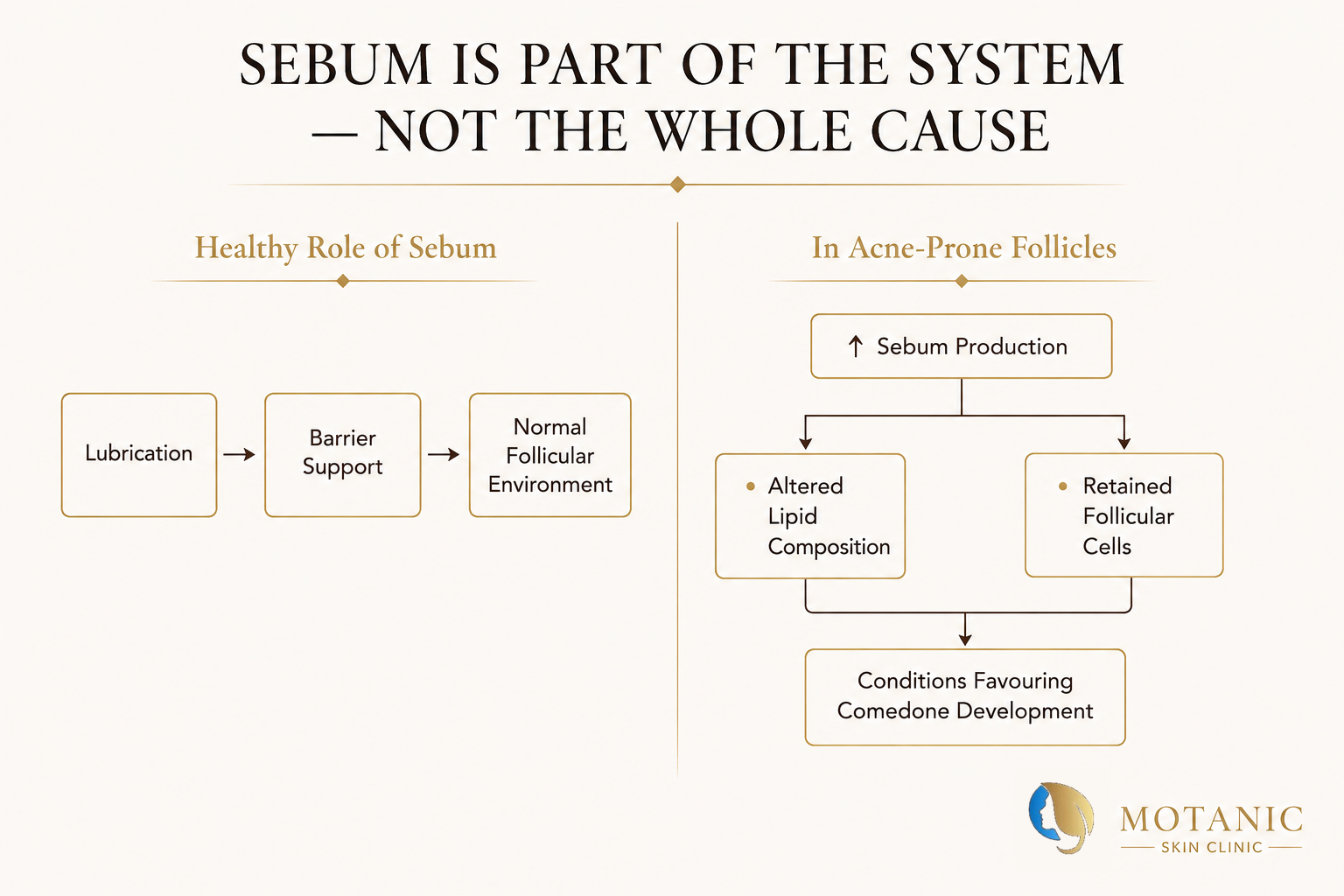
First, production itself often increases. Androgens — a group of hormones — stimulate the sebaceous gland’s cells to grow and become more active, driving greater sebum output. This is a necessary part of the picture in acne, though not sufficient on its own to explain it — plenty of factors affect how a given follicle responds to that increased supply.13
Second, and less widely known, the sebum itself can change in composition — not just how much is produced, but what it’s actually made of. In acne-prone skin, the balance of fatty acids shifts, levels of a compound called squalene tend to increase, and levels of linoleic acid — one specific fatty acid — tend to decrease.34 This composition shift appears to matter as much as the increase in volume, which is part of why “just less oil” doesn’t fully capture what’s happening. We touched on linoleic acid briefly in What Is Follicular Hyperkeratinisation? — lower relative levels of it have been proposed as one factor that may influence abnormal follicular keratinisation, though the exact causal relationship isn’t fully settled.4
Sebum doesn’t act alone
This is really the heart of it. Sebum interacts with what’s already happening inside the follicle — it doesn’t cause acne by itself, separate from everything else. Increased, compositionally-altered sebum meeting a follicle where cells are already being retained rather than shedding normally — the process we described in What Is Follicular Hyperkeratinisation? — creates conditions that favour comedone development in a way that neither factor produces on its own.3
There’s also a further downstream effect worth naming, even briefly: squalene, when it oxidises, has been shown to trigger inflammatory responses beyond simply contributing to a blockage.4 That’s a thread for a later article on inflammation — the point here is just that sebum’s involvement doesn’t stop at “clogging.”
It’s also worth knowing that sebum production isn’t uniform across the face or body — some areas naturally have a higher density of sebaceous glands than others, which is part of why acne tends to appear in fairly predictable regions rather than evenly across the skin.3 That’s a pattern worth being aware of, even though it doesn’t change what’s actually happening at the follicle level.
Sebum isn’t the villain of the story, and it isn’t innocent either. It’s one part of a system — and it’s what happens when that system changes together that matters, not oil in isolation.
Why “just remove the oil” misunderstands the biology
If excess surface oil were the whole explanation, thoroughly degreasing the skin should resolve acne on its own. It doesn’t reliably work that way, and this is why: the sebum you can see and feel on the surface isn’t where the relevant changes are happening. The composition shift, the interaction with retained follicular cells, the downstream inflammatory potential — none of that is addressed by removing what’s already reached the surface. It’s a bit like the lesson from Why Do Pores Get Clogged?: the story starts inside the follicle, not on top of it.
The androgen connection, briefly
Hormones — particularly androgens — are part of why sebum production increases in the first place, and this is one reason acne often changes around puberty, and can be influenced by hormonal shifts at other life stages too.1 Sebaceous glands don’t just passively receive hormonal signals either — they can respond to a range of regulatory pathways, which is part of why sebum production varies so much between individuals and across a person’s life.1 This is a substantial topic in its own right, with its own drivers and patterns, and we’ll cover it properly in a later article rather than trying to fit it in here.
What this means for treatment
Understanding sebum’s actual role explains why acne treatment isn’t simply about “drying out” the skin. Different approaches can target different parts of this picture — production itself, composition, or how sebum interacts with the follicle’s other processes — and what matters most tends to vary from person to person. We’ll go into treatment approaches properly in later articles; the point here is that the right starting point is understanding the mechanism, not assuming oil alone explains it.
Building a routine for acne-prone skin. Understanding the role of sebum doesn’t mean cleansing is unimportant — it means cleansing should be considered one part of a broader routine, not an attempt to strip every trace of oil from the skin. If you’re looking for a cleanser built around that idea, AcneClear Foaming Wash is formulated specifically for acne-prone skin.
If you’re not sure what’s actually driving your own skin, that’s exactly what a proper assessment is for.
References
- Del Rosso JQ, Kircik L. The primary role of sebum in the pathophysiology of acne vulgaris and its therapeutic relevance in acne management. Journal of Dermatological Treatment. 2024;35(1):2296855.
- Del Rosso JQ, Kircik L (as above); Ottaviani M, Camera E, Picardo M. Lipid Mediators in Acne. Mediators of Inflammation. 2010;2010:858176.
- Sutaria AH, Masood S, Saleh HM, Schlessinger J. Acne Vulgaris. StatPearls [Internet]. NCBI Bookshelf NBK459173.
- Letawe C, Boone M, Piérard GE. Digital image analysis of the effect of topically applied linoleic acid on acne microcomedones. Clinical and Experimental Dermatology. 1998;23(2):56–58.