
Motanic Skin Knowledge Library · Acne Scars & Skin Texture
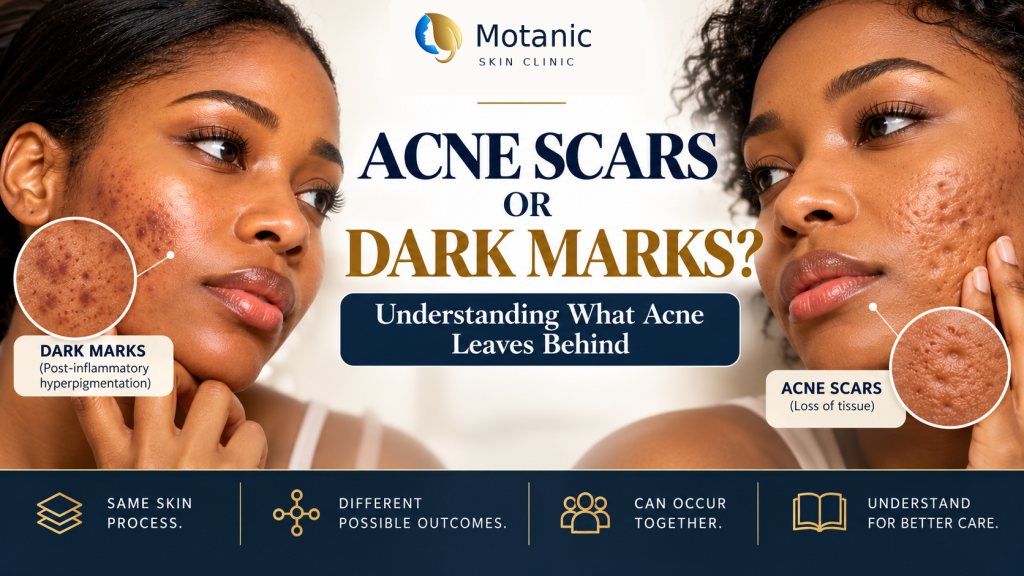
Acne scars vs dark marks: the difference is not simply how dark a spot looks. One involves pigmentation; the other involves changes in skin structure. Both can occur together. Here is how to understand what acne may leave behind—and why the distinction matters.
Acne scars vs dark marks: why the difference matters
Acne scars vs dark marks: how can you tell what a pimple has left behind? A breakout may settle while a flat brown patch, a depression, a raised area or several changes remain. These outcomes are often called “acne scars” in everyday conversation, but not every mark left by acne is a scar.
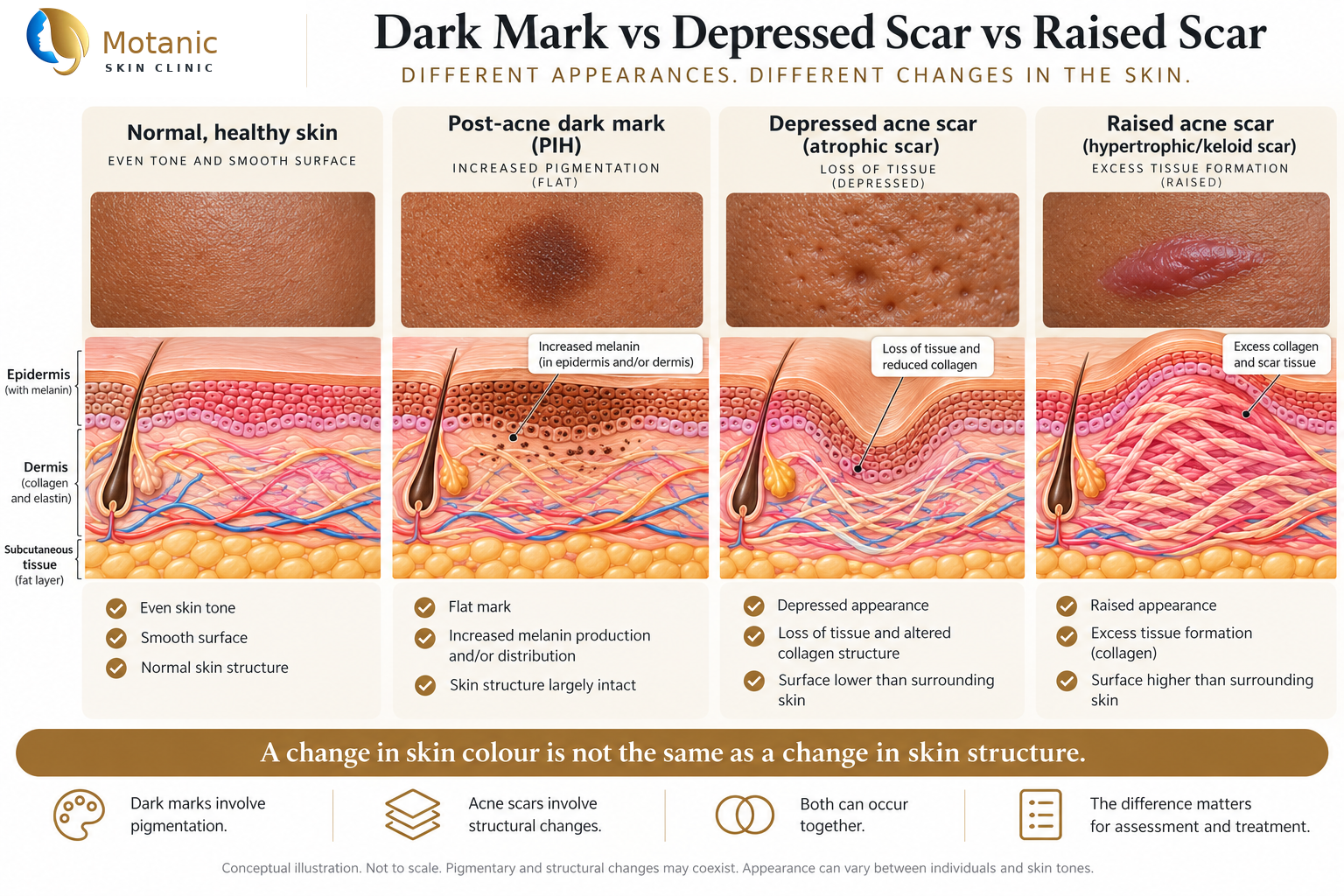
Post-acne dark marks primarily involve pigmentation. Acne scars involve persistent changes in tissue structure. Red or pink residual marks may reflect vascular colour changes instead. These findings can coexist, and their appearance alone does not always establish what is happening beneath the surface.
Understanding the distinction helps guide appropriate assessment and avoids treating every post-acne change as though it has the same cause.
Why acne can leave different outcomes
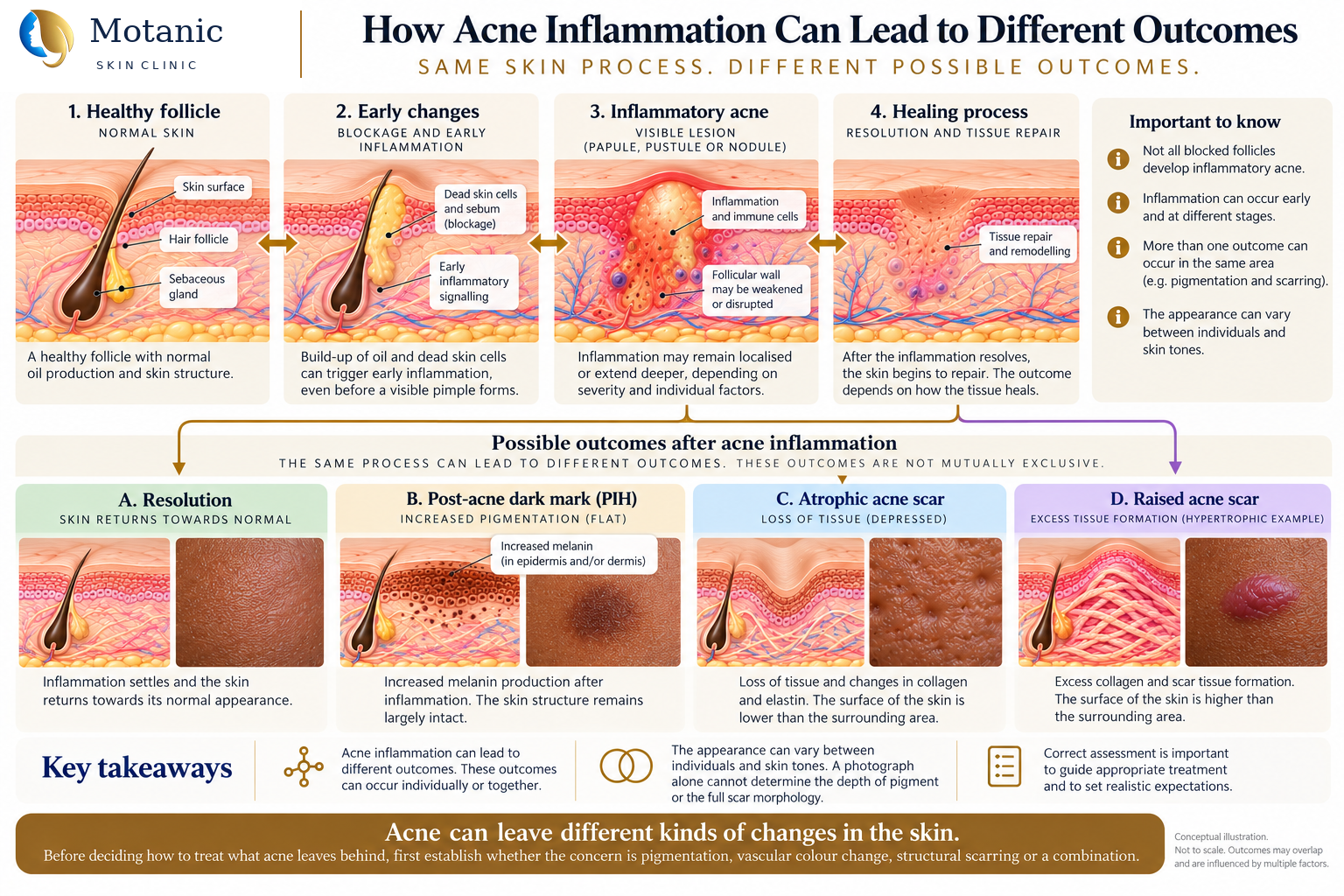
Acne develops in the pilosebaceous unit—the hair follicle and associated sebaceous gland. Follicular changes, sebum, microbial interactions and inflammatory signalling can influence one another. Inflammation may begin before a conspicuous red or painful pimple is visible.
Some lesions resolve without a lasting visible change. Others are followed by pigmentation, altered tissue contour or a combination. These are possible outcomes, not an inevitable sequence. A dark mark does not turn into a scar simply because it remains for a long time.
The appearance of an acne lesion does not reveal every inflammatory or tissue-remodelling event occurring beneath the skin.
What is a post-acne dark mark?
A flat dark mark after acne often represents post-inflammatory hyperpigmentation (PIH). The term acne-induced macular hyperpigmentation is also used in scientific discussions of acne-associated flat pigmentation.
Inflammatory signalling can influence melanocytes, the cells responsible for producing melanin, and can alter pigment production or distribution. Pigment may be present in the epidermis, dermis or both. The mark may appear brown, dark brown or greyish, but colour alone cannot reliably establish pigment depth.
PIH does not require a depression or raised area. It may persist after the active lesion has settled and does not necessarily mean acne is still active. For a fuller explanation, read Why Does Acne Leave Dark Marks?.
What is a structural acne scar?
An acne scar is a persistent alteration in skin architecture following acne-associated injury and repair. Tissue remodelling involves the extracellular matrix, including collagen. The resulting surface may become depressed or raised.
Atrophic (depressed) scars
Atrophic scars involve loss or alteration of supporting tissue. Common descriptive patterns include ice-pick scars (narrow and deep), boxcar scars (more defined edges) and rolling scars (broader undulating depressions, sometimes associated with tethering). Individual scars can have mixed features.
Hypertrophic and keloid scars
Raised scars involve excessive scar tissue formation. A hypertrophic scar generally remains within the original injury boundary; a keloid extends beyond it. They differ in behaviour and management and should not be treated as interchangeable. Raised scarring may occur on the chest, shoulders, back and jawline.
Dark marks versus acne scars: a practical comparison
| Feature | Post-acne dark marks (PIH) | Structural acne scars |
|---|---|---|
| Primary change | Melanin-related pigmentation | Tissue architecture and remodelling |
| Skin contour | Usually flat when PIH occurs alone | May be depressed or raised |
| Natural course | May gradually fade, sometimes slowly | Structural changes may persist |
| Management focus | Active acne, pigmentation and photoprotection | Scar morphology and individually appropriate care |
| Can they coexist? | Yes | Yes |
Important: persistent redness or pinkness may represent post-inflammatory erythema, a vascular colour change rather than PIH. A person may have pigmentary, vascular and structural changes in the same area.
How inflammation and healing influence the outcome
Inflammatory mediators can affect pigment-producing cells and melanin distribution. When tissue injury and repair involve extracellular matrix degradation or altered collagen deposition, structural scarring may result. The processes are related but are not identical.
More severe or persistent inflammatory acne is generally associated with increased scarring risk, yet outcomes vary. A small-looking lesion may leave noticeable pigmentation, while a lesion that did not appear especially severe may still be followed by scarring. Neither the darkness of a mark nor the size of a pimple is a reliable standalone measure of tissue injury.
Can a dark mark and a scar occur together?
Yes. One area can contain a depressed scar and increased pigmentation, or a raised scar with a colour change. The depression or elevation is structural; the colour change is a separate component.
Improving pigment does not necessarily correct scar contour. Likewise, improving texture does not automatically resolve pigment. Some scar-directed procedures can also provoke further inflammation and pigmentation, which makes individual assessment important.
Why this distinction matters in melanin-rich skin
PIH occurs across skin tones but may be especially noticeable or persistent in melanin-rich skin. Darker pigmentation does not automatically indicate deeper inflammation or more severe structural injury. Melanin-rich skin is normal, healthy skin, and its pigmentary biology influences how some inflammatory changes become visible.
Redness may be less visually apparent in some skin tones. Treatment planning must also consider the possibility of irritation, burns, further pigmentation or scarring following procedures. A technique that suits one person may not suit another.
Can you tell the difference by looking?
Flat pigmentation without an obvious contour change may suggest PIH. A persistent depression, raised area or altered texture may suggest scarring. But lighting, skin tone, concurrent inflammation and mixed findings can make visual interpretation difficult.
Clinical assessment may consider surface contour, texture, tissue mobility, history and examination under suitable lighting. Photographs and cosmetic skin-analysis images alone cannot reliably establish pigment depth or fully classify scar morphology.
New, changing, bleeding or otherwise concerning pigmented lesions should not automatically be attributed to acne; seek assessment from an appropriately qualified medical practitioner.
Why treatment decisions differ
For post-acne pigmentation
Management may involve reducing ongoing acne, gentle skincare, appropriate photoprotection and individually suitable pigment-directed treatments. Some topical agents, including retinoids and azelaic acid, may have roles depending on the circumstances. Improvement can be gradual, and no universal fading timeline applies.
For structural scarring
Different scar patterns may call for different approaches. Procedures considered in appropriate clinical settings include microneedling, subcision, selected chemical reconstruction methods and laser-based treatments. These are not interchangeable, and the quality of evidence varies by procedure and scar type.
Some procedures require medical or specialist assessment. Suitability depends on scar morphology, active acne, skin characteristics, medical history, treatment risks and the treating professional’s qualifications. Benefits are not guaranteed; adverse effects can include pigmentation changes and additional scarring.
The treatment plan should follow the identified concern—not simply the word “scar” used to describe it.
Reducing the risk of further marks and scars
Managing ongoing acne matters because repeated lesions can create new opportunities for pigmentation and structural injury. Avoid picking, squeezing or unnecessarily traumatising lesions. Use skincare that your skin tolerates, and consider appropriate sun protection as part of pigmentation management.
Persistent inflammatory acne, nodules, deep painful lesions or early signs of scarring warrant timely medical assessment. Prevention cannot guarantee that pigmentation or scarring will never occur, but effective management of active acne can help reduce additional damage.
When to seek professional assessment
Seek advice if you cannot distinguish a mark from a scar, notice developing depressions or raised scars, experience persistent painful acne, or are considering a procedure intended to remodel skin tissue.
Motanic Skin Clinic offers consultation and cosmetic skin analysis to discuss visible concerns, relevant history and appropriate next steps. Cosmetic assessment does not replace medical diagnosis; concerns outside the practitioner’s scope should be referred appropriately.
Frequently asked questions
Are dark spots from acne scars?
Not necessarily. Flat post-acne pigmentation can be PIH rather than structural scarring; both may coexist.
Can a dark mark become a scar?
Persistent pigmentation does not automatically transform into a structural scar. They are distinct possible outcomes of acne.
Can acne scars also look dark?
Yes. A structural scar may also contain pigmentation or another colour change.
Do depressed acne scars fade on their own?
Some scars become less noticeable, but established structural changes may persist and may require scar-specific assessment.
Can I identify deep pigment from the colour of a mark?
No. Appearance alone cannot reliably establish pigment depth or diagnosis.
Is microneedling appropriate for every acne scar?
No. Suitability varies by scar type, skin characteristics, clinical circumstances and practitioner qualifications.
What about red or pink marks after acne?
Some residual colour changes involve blood vessels and are called post-inflammatory erythema, which differs from PIH and scarring.
Should I treat active acne before scars?
Ongoing acne needs appropriate management because new lesions may lead to additional marks or scars. Timing and treatment sequencing require individual assessment.
The key takeaway
Before deciding how to treat what acne leaves behind, establish whether the concern is pigmentation, vascular colour change, structural scarring or a combination.
Dark marks and acne scars are related to acne, but they are not the same finding. Understanding what is present supports better decisions and more realistic expectations.
For background, read Why Does Acne Leave Dark Marks?, Acne Inflammation and Types of Acne Lesions.
Scientific references and further reading
- Connolly D, Vu HL, Mariwalla K, Saedi N. Acne Scarring—Pathogenesis, Evaluation, and Treatment Options. J Clin Aesthet Dermatol. 2017;10(9):12–23.
- Fabbrocini G, Annunziata MC, D’Arco V, et al. Acne Scars: Pathogenesis, Classification and Treatment. Dermatol Res Pract. 2010;2010:893080.
- DermNet — Acne scarring.
- DermNet — Postinflammatory hyperpigmentation.
- American Academy of Dermatology — Acne scars: Diagnosis and treatment.
Educational information only. This article does not provide an individual diagnosis, treatment prescription or guarantee of results. Clinical assessment is needed where appropriate.