
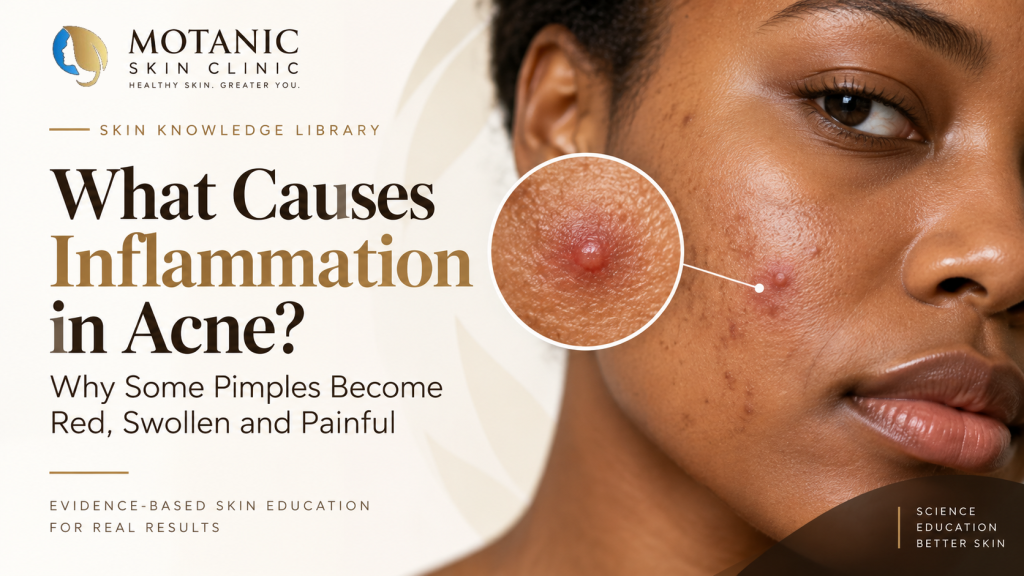
A blackhead can sit quietly on the skin for weeks without feeling sore. Then there’s the completely different kind of acne lesion — red, raised, tender, sometimes genuinely painful.
So what changed? The obvious answer is inflammation. That’s true — but there’s an important complication: inflammation doesn’t necessarily begin the moment a pimple turns red.
What you’re seeing on the surface is the visible expression of a biological response that’s often been developing inside and around the follicle for longer than it appears. That’s the idea this article is built around.
First, what actually is inflammation?
Acne inflammation isn’t the skin malfunctioning for no reason. It’s part of how the immune system responds when tissue detects signals that something has changed. In acne, that response is centred on the pilosebaceous unit — the structure we described in Understanding the Pilosebaceous Unit.
Inflammation may be present earlier than you think
The traditional way of dividing acne lesions is simple: blackheads and whiteheads are “non-inflammatory,” while papules and pustules are “inflammatory.” That distinction is clinically useful, but biologically it’s incomplete.1
Research has identified inflammatory cells and inflammatory signalling around very early acne lesions — including around the microcomedone we described in Why Do Pores Get Clogged? and again in What Is a Comedone?.12 A 2024 review specifically looking at cell types present in early acne lesions found that immune cell infiltration and cytokine activity are already detectable at this early stage, well before a lesion looks clinically inflamed.2 Inflammation, in other words, appears to be involved throughout much more of acne lesion development than the older, strictly sequential model suggested.
So when we call a blackhead “non-inflammatory,” what we really mean is that it doesn’t show the obvious clinical signs of inflammation we associate with a red, swollen pimple. It doesn’t necessarily mean no inflammatory biology is happening at all — it means that biology hasn’t yet produced something visible.
Where does Cutibacterium acnes fit?
Cutibacterium acnes — often shortened to C. acnes — is closely involved in acne biology. But simply finding C. acnes on someone’s skin doesn’t mean that person has acne. C. acnes normally lives on sebaceous skin, acne or not.3
Contemporary research focuses less on the sheer quantity of bacteria present, and more on microbial balance, specific strains, and how the organism interacts with the host’s immune system.6 One specific mechanism worth knowing: a receptor on skin cells called TLR2 acts as a kind of sensor, helping recognise C. acnes and triggering the release of inflammatory signals in response.4 This is one piece of a broader innate immune response — current research also describes related pathways, including a structure called the NLRP3 inflammasome, contributing to the same general process.5 We won’t go deeper into the specific receptor biology here; the point that matters is the shape of the mechanism, not every molecular detail. The bacterium is part of an ecosystem and an immune interaction — not simply an infection sitting inside a dirty pore.
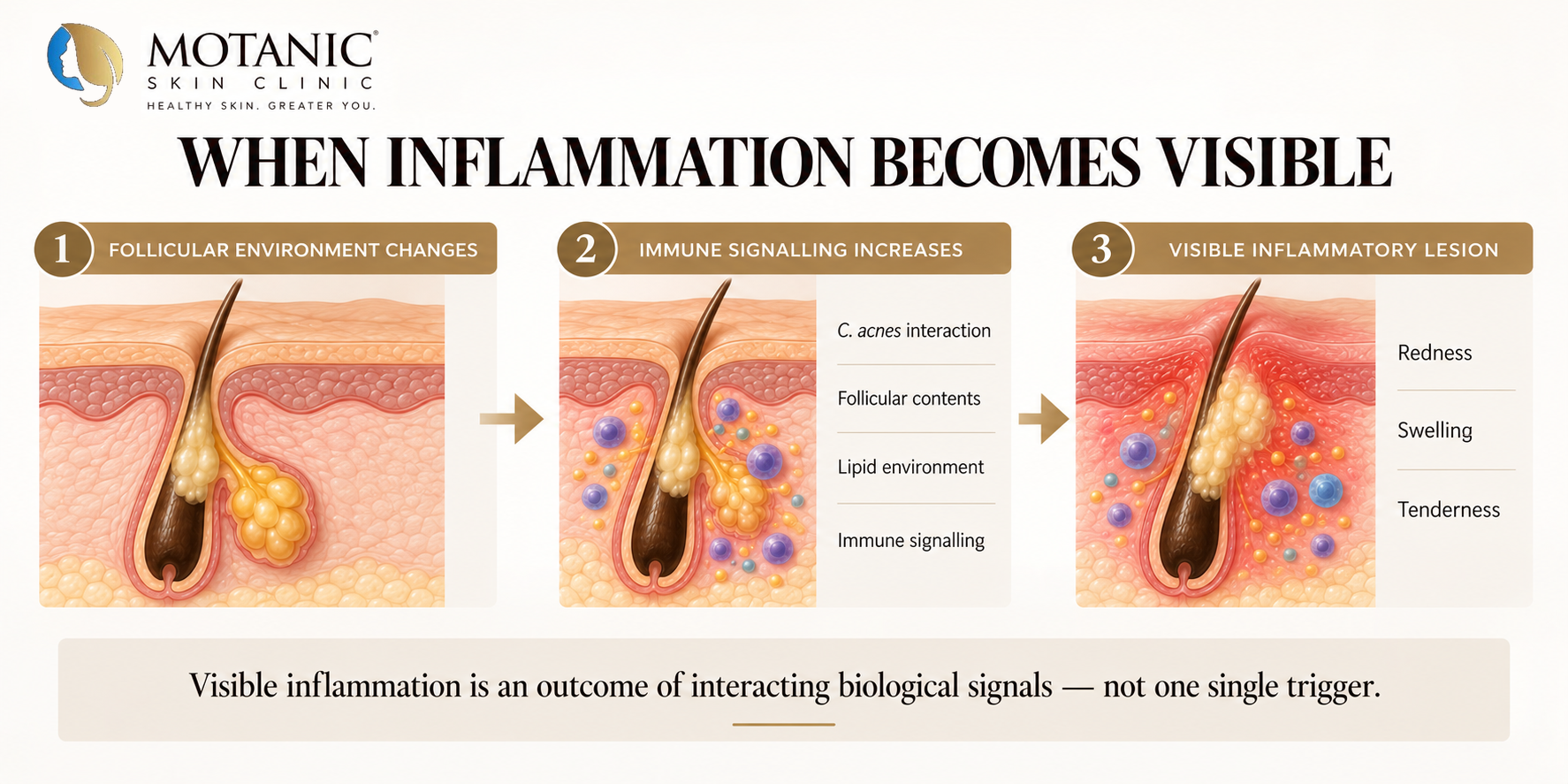
Visible inflammation is an outcome of interacting biological signals — not one single trigger.
Why does the pimple become red and swollen?
Once immune signalling is underway, inflammatory mediators alter the local tissue environment and recruit immune cells to the area.5 Clinically, this produces the features people recognise as an inflammatory acne lesion: redness, swelling and tenderness.
Two common terms are worth distinguishing precisely: a papule is a raised inflammatory lesion without visible pus, while a pustule is an inflammatory lesion that does contain visible purulent material. Deeper inflammatory lesions — nodules and cysts — involve more extensive tissue involvement and genuinely deserve their own article rather than being compressed into a couple of sentences here.
What about follicular rupture?
This is another place acne explanations often oversimplify. As inflammatory processes intensify, the follicular wall can become disrupted, allowing follicular material to enter the surrounding tissue and provoke a stronger inflammatory reaction.1
Follicular rupture can intensify inflammation. It shouldn’t, however, be mistaken for the moment inflammation first begins — the evidence for early inflammatory activity doesn’t support that simpler sequence.
Why this matters for acne treatment
If acne were simply a problem of excess bacteria, reducing bacteria alone should resolve it completely. If it were simply blocked pores, clearing visible blockages should be enough. Neither explanation captures the full biology.
Acne involves interconnected processes: the anatomy described in Understanding the Pilosebaceous Unit, the altered shedding covered in What Is Follicular Hyperkeratinisation?, the sebum biology from Sebum and Acne, the comedone formation described in What Is a Comedone?, and the immune and inflammatory signalling covered here. None of these pieces operates entirely independently — current reviews increasingly describe acne as arising from the interaction between genetic predisposition and several converging biological processes, rather than any single cause acting in isolation.5
That’s really the practical value of understanding inflammation properly: it explains why acne treatment so often needs to work on more than one front at once, rather than assuming that fixing any single piece — bacteria, oil, or blocked pores alone — will resolve the whole picture.
References
- Jeremy AHT, Holland DB, Roberts SG, Thomson KF, Cunliffe WJ. Inflammatory events are involved in acne lesion initiation. Journal of Investigative Dermatology. 2003;121(1):20–27.
- Huang L, Yang S, Yu X, Fang F, Zhu L, Wang L, Zhang X, Yang C, Qian Q, Zhu T. Association of different cell types and inflammation in early acne vulgaris. Frontiers in Immunology. 2024;15:1275269.
- Toyoda M, Morohashi M. Pathogenesis of acne. Medical Electron Microscopy. 2001;34(1):29–40.
- Zhang B, Choi YM, Lee J, An IS, Li L, He C, Dong Y, Bae S, Meng H. Toll-like receptor 2 plays a critical role in pathogenesis of acne vulgaris. Biomedical Dermatology. 2019;3:4.
- Han S, Ding Z, Zheng J, Bai H, Xu H, Ren X, Li M. The Inflammatory Basis of Acne Pathogenesis. Dermatology. 2026;242(4):399–410.
- Li J, Wang F, Liu D, Yang W, Sun H, Gao M, Chen D, Xu H. Transcriptomic Profiling of Cutibacterium acnes IA1-Infected Keratinocytes Reveal Hub Genes and CLR Pathway in Acne Pathogenesis. Current Issues in Molecular Biology. 2026;48(1):34.