
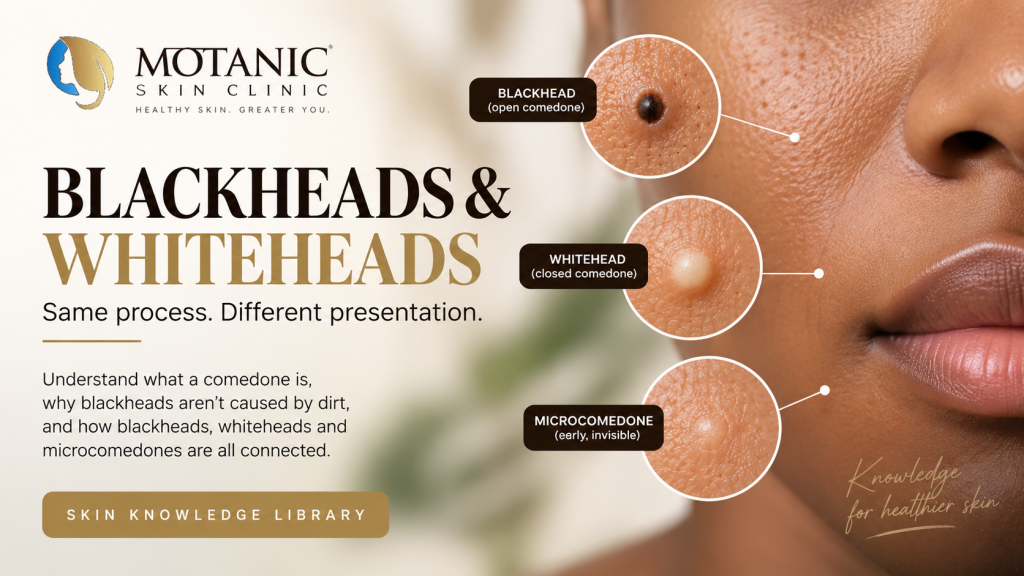
Blackheads and whiteheads look different enough that it’s easy to think of them as two separate problems.
Biologically, they’re much more closely related than they appear.
What does “comedone” actually mean?
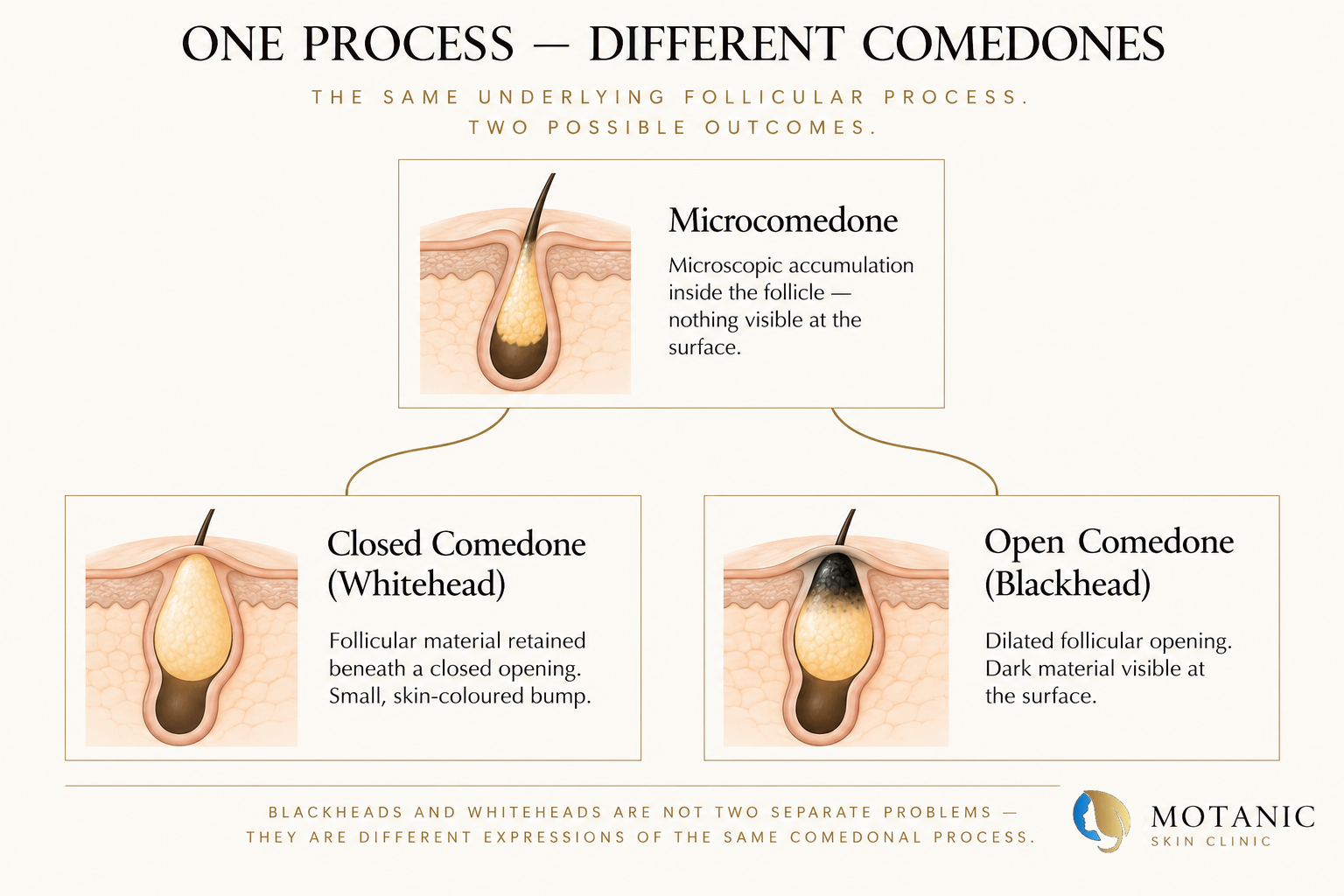
A comedone is simply a clogged follicle associated with acne.1 It’s an umbrella term — not one specific type of blemish, but a family that includes the microcomedone, the closed comedone, and the open comedone. Understanding that family relationship is really the point of this article: once you can see how these three relate to each other, “blackhead” and “whitehead” stop feeling like separate diagnoses and start reading as two variations on one process.
All of this happens within the same structure we described in Understanding the Pilosebaceous Unit — the follicular opening, the canal, and the material that can accumulate within it. If any of that terminology feels unfamiliar, that article is the place to start.
It’s worth being precise about the family relationship too. A microcomedone isn’t automatically destined to become a closed or open comedone in some fixed order — it’s the earliest, invisible starting point, and what happens next depends on what’s happening at the follicular opening above it, not a guaranteed sequence every follicle follows the same way.
It starts before you can see it
We explained how this microscopic blockage develops in Why Do Pores Get Clogged? — retained cells and sebum accumulate within the follicle, forming what’s called a microcomedone, long before anything is visible on the surface.1 That article covers the mechanism in full; here, we’re picking up the story at the point where it does become visible.
What is a closed comedone?
A closed comedone — what most people call a whitehead — forms when keratin and sebum accumulate within a follicle that stays closed or narrow at the surface.2 Because the opening stays sealed, the material underneath isn’t exposed to air, and the lesion presents as a small, pale or skin-coloured bump, usually without any visible follicular opening at its centre.
One thing worth correcting: a whitehead isn’t necessarily “pus trapped under the skin.” Pus is a sign of inflammation, and comedones — both open and closed — are non-inflammatory by definition.2 What you’re seeing in a whitehead is retained follicular material, not an infection.
What is an open comedone?
An open comedone — a blackhead — is the same underlying process, but the follicular opening is dilated rather than closed.2 That structural difference is really the entire distinction between the two: same accumulation, different state of the opening above it. Clinically, an open comedone typically shows a visible, dilated opening at its centre — the follicular structure itself is easier to see, precisely because it isn’t sealed shut the way a whitehead’s is.
Why is a blackhead black?
This is worth getting right, because it’s one of the places skincare content routinely oversimplifies. The common explanation is that “sebum oxidises and turns black” — that’s not quite accurate.
What actually happens: because the follicular opening in an open comedone is dilated, the keratin-containing material inside is exposed to air. That exposure leads to oxidation and the accumulation of melanin granules within the material — and it’s that process, not simple oil oxidation, that produces the dark appearance.2 It’s a genuinely different mechanism from “the oil turned brown,” even though the everyday version of that explanation isn’t entirely wrong in spirit — air exposure really is the trigger. It’s the specifics that matter: what’s oxidising, and melanin’s role in it, rather than sebum alone darkening on contact with air.
And to be direct about the misconception this corrects: the dark material in a blackhead is not dirt, and it isn’t there because of poor cleansing. We made a related point in Why Do Pores Get Clogged? about clogged pores generally — the same principle applies here specifically to why blackheads look the way they do.
Comedones can look different across skin tones
Most explanations of blackheads and whiteheads assume a particular baseline skin colour, but comedones don’t present identically on every skin tone. Across skin pigmentations generally, comedones can present as skin-coloured lesions that are genuinely difficult to appreciate visually — the underlying biology is the same, but the appearance a reader might expect from typical skincare content isn’t always what shows up in practice.2
This has a real practical consequence: skin-coloured comedones that are hard to distinguish from the surrounding skin have been specifically documented as a factor that can lead to delayed or incorrect diagnosis of acne.2 It’s part of why an accurate assessment benefits from real experience across a full range of skin presentations, rather than relying on the single presentation most commonly shown in general skincare content.
Same follicle, same underlying process — the colour you see is a difference in exposure to air, not a difference in cleanliness.
Blackheads vs. whiteheads
| Open comedone | Closed comedone | |
|---|---|---|
| Common name | Blackhead | Whitehead |
| Follicular opening | Open / dilated | Closed / narrow |
| Appearance | Dark central material | Small pale or skin-coloured bump |
| Caused by dirt? | No | No |
| Inflammatory? | No — non-inflammatory | No — non-inflammatory |
Are blackheads and whiteheads acne?
Yes. This is worth stating explicitly, because many people picture “acne” as inflamed, red pimples only. Comedonal acne — blackheads and whiteheads, without inflammation — is genuinely acne, not a separate or lesser condition sitting alongside it.2 It’s an earlier point on the same continuum we’ve been describing throughout this series, not a different problem entirely.
Where comedones typically appear
Comedones form within follicles that have especially active sebaceous glands, so they tend to cluster wherever those glands are most concentrated — commonly the face, particularly the nose, forehead and chin, as well as the chest and back.1 That’s not a separate phenomenon from everything we’ve covered so far; it’s the same follicular process we’ve described throughout this series, simply more active in the areas where sebaceous glands themselves are most dense.
What this means for skincare and treatment
Understanding the difference matters because blackheads and whiteheads aren’t simply surface dirt that needs to be scrubbed away. Their formation begins within the follicle, so aggressive cleansing doesn’t address the biological process that produced them — the process described in Why Do Pores Get Clogged? and What Is Follicular Hyperkeratinisation?.
We’ll cover treatment approaches for comedonal acne specifically in a later article. The point here is simpler: treating a whitehead like an infection, or a blackhead like a dirt problem, starts from the wrong premise entirely.
Does picking or squeezing help?
It’s worth addressing directly, since it’s one of the most common instincts. Manually squeezing a comedone might temporarily remove some of the visible material, but it doesn’t change the underlying follicular process that produced it — the accumulation, altered shedding, and follicular environment we’ve covered across this series are all still there, unaddressed. Mechanical pressure can also affect the surrounding follicular tissue in ways that aren’t obvious right away. None of this is a reason for alarm if it’s something you’ve done — it’s simply worth knowing that it addresses the visible result, not the mechanism behind it.
References
- Sutaria AH, Masood S, Saleh HM, Schlessinger J. Acne Vulgaris. StatPearls [Internet]. NCBI Bookshelf NBK459173.
- Wong CM, Guo C, Scheufele CJ, Nguyen DA, Charles JEM, Carletti M, Weis SE. Presentations of Cutaneous Disease in Various Skin Pigmentations: Acne Vulgaris — Comedonal Acne. HCA Healthcare Journal of Medicine. 2024;5(1):19–25.