
Motanic Skin Knowledge Library · Pigmentation & Dark Marks
Why does acne leave dark marks even after a pimple heals? The answer involves inflammation, melanocyte activity and changes in melanin production. Understanding these processes helps explain why pigmentation can remain after acne resolves—and why a dark mark is not automatically a scar.
Why Does Acne Leave Dark Marks After Pimples Heal?
A pimple can settle while the skin remains darker in the same place. The raised lesion and the residual colour change are related, but they do not necessarily resolve at the same rate.
Acne involves changes in the hair follicle and the surrounding tissue. During its development, inflammatory activity can affect nearby pigment-producing cells. Even when swelling and tenderness improve, the pigmentary consequences of that activity may remain visible.
Acne resolution describes the settling of an active lesion. Pigment resolution describes the gradual reduction in residual pigmentation. These are different biological processes, which is why a flat mark does not automatically indicate continuing acne.
What is post-inflammatory hyperpigmentation?
Post-inflammatory hyperpigmentation (PIH) is increased pigmentation that occurs in association with skin inflammation or injury. Acne is one possible trigger; eczema, insect bites, burns and other inflammatory conditions can also be followed by PIH.
Acne-associated PIH often appears as a flat brown, dark-brown or sometimes greyish area at the site of a previous lesion. It is not necessarily a scar, and it is not proof that infection or active inflammation remains.
Some researchers use the term acne-induced macular hyperpigmentation (AMH). “Macular” means flat. This terminology recognises that inflammatory activity can occur during acne development, not only after a pimple visibly heals. PIH remains a widely understood term, so we use it here while acknowledging the terminology distinction.
Not every dark spot is PIH. Similar-looking changes may have other causes, and a changing or unusual pigmented lesion should not simply be assumed to be an acne mark.
How healthy skin produces pigment
Melanin is a normal pigment that contributes to skin colour and offers some protection against ultraviolet radiation. It is produced by specialised cells called melanocytes, located mainly in the basal layer of the epidermis.
Melanin is produced and packaged in structures called melanosomes. Melanosomes are transferred from melanocytes to neighbouring keratinocytes, contributing to the pigmentation visible at the skin surface.
People with different skin tones generally have broadly comparable numbers of melanocytes in corresponding body regions. Differences in melanin production, melanosome characteristics, distribution and persistence help explain differences in visible skin colour.
Melanin itself is not a problem to eliminate. PIH involves an unwanted change in pigmentation after inflammation, rather than the presence of melanin in healthy skin.
Where inflammation enters the acne process
Acne develops in the pilosebaceous unit—the hair follicle and its associated sebaceous gland. Changes in follicular cell shedding and sebum can contribute to an early microscopic blockage called a microcomedone. Changes in the follicular environment, microbial activity and immune signalling can then interact as acne develops.
Inflammation is not restricted to a visibly red or painful pimple. Inflammatory processes may occur at different stages of acne, including stages with limited obvious surface change. Skin cells and immune cells communicate through signalling molecules that influence tissue responses, including the behaviour of neighbouring cells.
Some inflammation remains relatively localised, while other lesions involve more surrounding tissue. The appearance of a lesion does not reveal every biological event occurring beneath the surface.
How inflammation can influence melanocytes
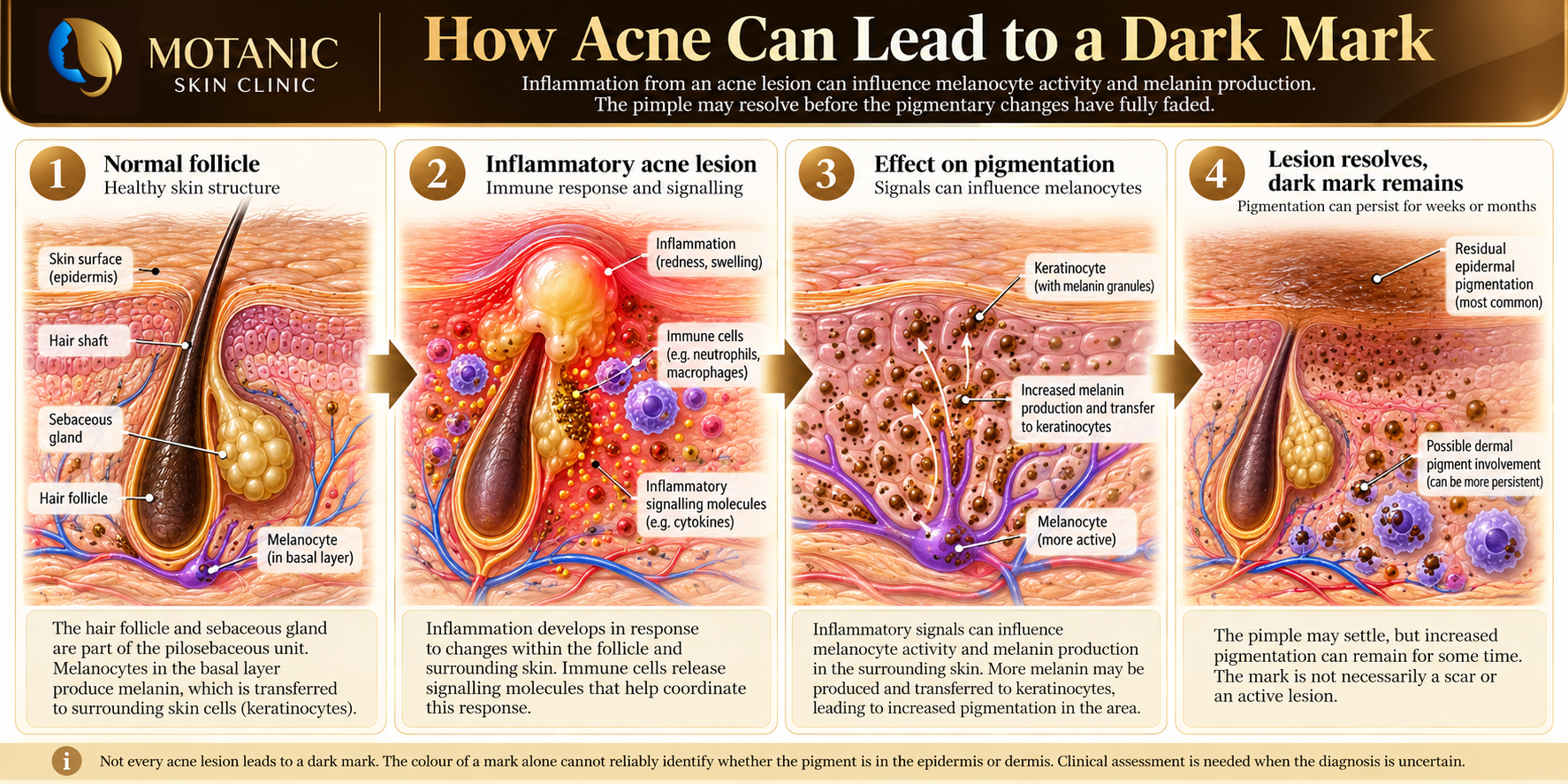
Inflammation and pigmentation are connected. During inflammatory responses, skin and immune cells release mediators that can influence melanocyte activity and pathways involved in melanin synthesis. In some circumstances, this contributes to increased or redistributed pigment at the site of an acne lesion.
The mechanism is multifactorial. Research has implicated several inflammatory and pigment-regulating pathways, but no single mediator explains every case of acne-associated pigmentation. A useful educational model is:
Acne-related inflammation → altered pigment regulation → visible residual pigmentation.
This is a possible pathway, not an inevitable outcome of every breakout. The acne-specific review by Elbuluk and colleagues describes inflammatory melanogenesis and abnormal melanin deposition; the exact contribution of individual pathways remains incompletely established. The diagram below illustrates the relationship without implying that every lesion must leave a mark.
Why pigmentation can outlast the lesion
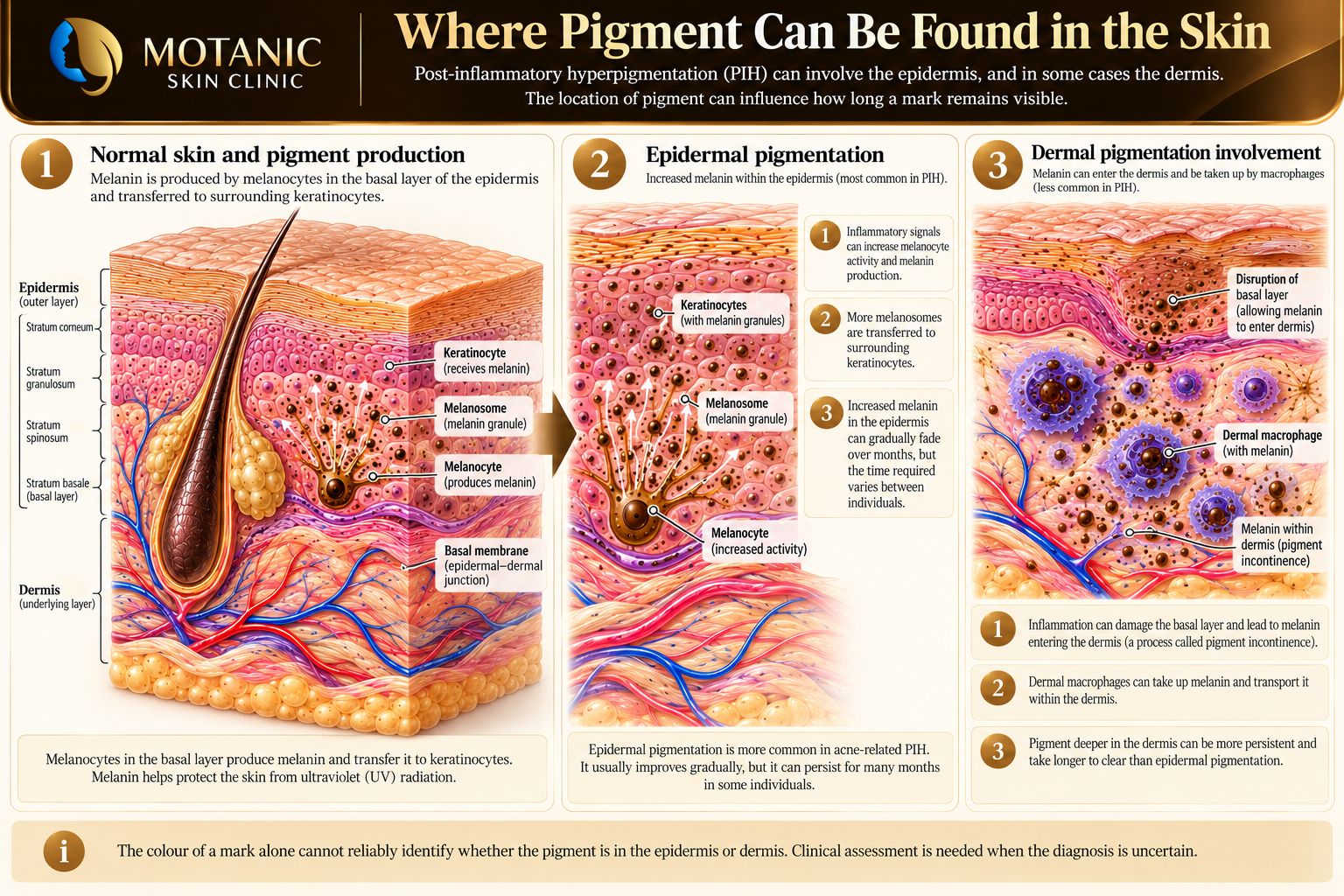
When an inflamed pimple settles, its swelling and tenderness may disappear before pigment deposited or redistributed during the inflammatory episode has cleared. The location of the pigment is one factor that can influence persistence.
Epidermal pigmentation
When increased melanin is mainly within the epidermis, its appearance may gradually lessen through normal epidermal renewal and pigment clearance. The rate varies, particularly when ongoing inflammation or light exposure contributes to further pigmentation.
Dermal pigment involvement
In some inflammatory conditions, damage affecting the basal epidermis and the epidermal–dermal interface can allow melanin to enter the dermis. Macrophages may take up that pigment, which can then remain visible for a prolonged period. This process is sometimes called pigment incontinence.
Not every acne-related dark mark involves the dermis. Although dermal pigmentation may have characteristic clinical hues, colour alone cannot establish pigment depth: a brown or greyish mark, photograph or cosmetic skin-analysis image is not definitive evidence of where pigment is located.
Why some pimples leave marks and others do not
Two acne lesions can appear similar and still have different pigmentary outcomes. Possible influences include the nature and duration of inflammation, individual pigmentary responses, repeated tissue injury and continuing breakouts.
Picking or squeezing can add inflammation or injury. Recurring lesions can produce new marks before older ones have faded. Yet lesion size or pain does not reliably predict how dark or persistent the eventual mark will be.
PIH can occur after acne with little obvious redness or swelling. Redness may also be less visible in some skin tones, so its absence does not prove the absence of inflammatory activity.
Why dark marks matter in melanin-rich skin
PIH can affect any skin tone, but it is frequently a particularly important concern in melanin-rich skin. Differences in normal pigmentation biology can affect how noticeable an inflammatory pigmentary response becomes and how long it persists.
A visible mark does not establish that a person had more severe inflammation. Inflammatory intensity and visible pigmentary contrast are not interchangeable measurements. Melanin-rich skin is healthy skin with its own normal biology, not a disorder.
This article provides the shared mechanism across skin tones. A separate Motanic Knowledge Library article is planned to examine melanin-rich skin in greater detail; it is not linked here until published.
Why recurring acne creates overlapping dark marks
Imagine one lesion healing and leaving a mark. That mark begins to fade, but a second breakout develops nearby, followed by a third. The skin may now show active acne, newly formed marks and older fading marks at the same time.
To the person looking in the mirror, the pigmentation may appear unchanged even while individual marks improve. This is why management of ongoing acne matters when the goal is also to reduce the accumulation of new marks.
Managing pigmentation alone may leave the trigger for new pigmentation unresolved.
Sunlight, visible light and pigmentation
Ultraviolet radiation can contribute to increased pigmentation and may worsen existing PIH. Visible light can also be relevant to certain pigmentary conditions, especially in darker skin tones.
Appropriate photoprotection can include shade, protective clothing and consistent use of suitable broad-spectrum sunscreen. Tinted sunscreens containing iron oxides may provide useful additional visible-light protection for some people with pigmentation concerns.
Sunscreen does not instantly erase pigment already present. Its role is to help reduce further light-related pigmentation as part of a broader plan.
Why aggressive exfoliation can backfire
It can be tempting to scrub persistent marks or combine multiple strong skincare products. But irritation is itself capable of provoking inflammation. In skin prone to PIH, additional inflammation may contribute to further pigmentation.
A possible cycle is persistent mark → aggressive treatment → irritation → more inflammation → additional pigmentation. This does not mean that exfoliation or procedures are always inappropriate. It means the intervention must be selected with regard to skin tolerance, expected benefit and risk.
Chemical peels, laser treatments and other procedures can be useful in selected situations, but they can also aggravate pigmentation if poorly matched or performed. More intensive treatment is not necessarily better treatment.
How long do post-acne marks last?
There is no reliable single fading timeline. Some marks gradually become less noticeable over months; others persist much longer. The nature of the pigmentation, continued inflammation, light exposure, individual skin characteristics and treatment tolerability all matter.
Dermal pigment involvement may be particularly persistent, but cannot be diagnosed from a mark’s appearance alone. Claims that every mark will disappear within a fixed number of weeks are not justified.
Improvement is also different from complete clearance. A treatment may reduce the visibility of pigmentation without removing every mark.
What treatment evidence can—and cannot—tell us
Management often considers both active acne and residual pigmentation. Reducing ongoing acne can help limit the formation of new marks. Selected topical treatments, including some retinoids and azelaic acid, may have roles depending on the person and their circumstances.
Some procedural treatments may also be considered after individual assessment. Their suitability depends on the diagnosis, skin characteristics, tolerability, possible adverse effects and the experience of the treating professional.
Evidence strength matters. The 2023 Delphi consensus supports early effective acne management and consideration of pigmentation-directed care; its authors explicitly note the lack of large randomised controlled trials on combined acne and acne-associated hyperpigmentation management. Not every intervention is backed by strong comparative trials. It would be misleading to imply that any one product or procedure is universally effective or guaranteed to clear PIH.
This article does not provide an individual treatment prescription. Medicines and procedures should be considered with appropriately qualified clinicians where necessary.
Dark marks versus acne scars
A flat area of residual pigmentation is different from a structural change in the skin. PIH primarily involves altered pigmentation, whereas acne scars involve changes in tissue structure that may produce depressed or raised areas and altered texture.
Both can occur together, and appearance alone may not always distinguish them confidently. Our separate article on acne scars versus dark marks will address this comparison in depth when published.
When to seek professional assessment
Professional advice can be useful if acne continues to recur, pigmentation remains persistent, a mark is difficult to identify or you are considering stronger treatments or procedures.
A new, changing, bleeding or otherwise concerning pigmented lesion should not be assumed to be an acne mark. Seek assessment from an appropriately qualified medical practitioner. Cosmetic skin analysis does not replace medical diagnosis.
Frequently asked questions
Why does a pimple leave a brown spot?
Inflammation associated with acne can influence pigment-producing cells, leaving visible pigmentation after the lesion settles.
Does a dark mark mean acne is still active?
Not necessarily. A flat residual mark may remain after the active lesion has resolved.
Why does acne leave dark marks even after a small pimple?
Yes. Noticeable pigmentation can occur even when the original acne appeared mild.
Can I tell whether pigment is deep by its colour?
No. Colour alone cannot reliably determine pigment depth or diagnosis.
Are dark marks permanent?
Not always. Some fade gradually, while others persist for long periods; outcomes vary.
Can acne scars and dark marks occur together?
Yes. Pigmentary changes and structural scarring can coexist.
Will sunscreen remove a dark mark?
Sunscreen does not directly erase existing pigment, but appropriate photoprotection can help limit further darkening.
Should I address acne or pigmentation first?
When acne is ongoing, managing new lesions is important because each breakout may create another mark. Both concerns can be considered together.
The key takeaway
A pimple and the dark mark it leaves are related, but they are not the same thing. Acne-related inflammation can influence pigment production and distribution. The pigmentary change may remain after the active lesion settles.
Understanding the process helps explain why prevention of new inflammation, gentle skin care, appropriate photoprotection and individually suitable treatment matter.
For more on acne biology, read Acne Inflammation, Types of Acne Lesions and The Role of Cutibacterium acnes.
Scientific references and further reading
Educational information only. This article does not replace medical assessment, diagnosis or treatment advice.